
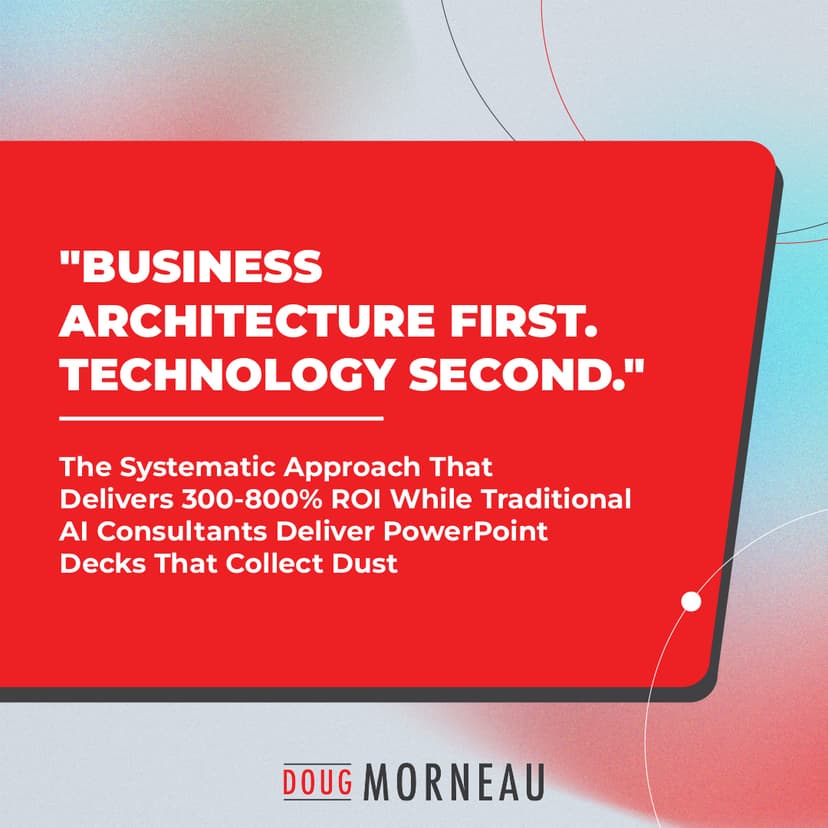
Why AI Fails Without Execution Architecture
Most AI initiatives don’t fail because the technology doesn’t work — they fail because organizations chase tools instead of ROI-driven execution architecture.
This is how most AI initiatives actually unfold:
- A new AI tool is approved because competitors are using it
- A pilot is launched inside one department
- The demo looks impressive, but ownership is unclear
- Manual handoffs and approvals remain untouched
- Reporting is still requested manually
- ROI is assumed, not measured
- Momentum stalls before results compound
- None of these are technology problems. They’re execution design failures.
- Artificial intelligence is no longer theoretical.
Organizations are investing heavily. Leadership teams are under pressure to “do something.” Vendors promise speed, efficiency, and transformation. The conversation feels urgent, unavoidable, and increasingly noisy.
And yet, beneath the activity, a paradox keeps showing up.
Despite significant investment, many AI initiatives struggle to produce meaningful return. Pilots stall. Momentum fades. Results feel disconnected from effort. Leaders sense that something is wrong—but struggle to articulate what.
This isn’t because AI is immature.
It’s because most organizations are trying to apply intelligence to systems that were never designed to absorb it.
The False Promise of Tools
The current AI conversation is dominated by tools.
New platforms. New copilots. New agents. New stacks.
Each one promises leverage—often with a compelling demo that works perfectly in isolation.
This framing feels logical. AI arrives as technology, so the instinct is to respond with technology.
But this is where most organizations quietly lose the game.
Tools don’t create leverage. They amplify whatever structure already exists underneath them. When execution is unclear, fragmented, or dependent on human workarounds, adding more capability doesn’t create progress—it creates activity.
That distinction matters.
Many AI initiatives don’t fail outright. They function. Something ships. Something works. But the return never materializes in a meaningful way. The effort looks impressive. The outcome doesn’t move the business.
This is how organizations burn time, budget, and political capital without being able to explain why the payoff never arrived.
Tool-first thinking assumes execution problems are mechanical—that if the right software is installed, friction will disappear. In reality, execution problems are architectural. They live in ownership gaps, broken handoffs, delayed feedback loops, and invisible decision paths.
Software can’t fix those conditions. It can only expose them.
The more advanced the tool, the more clarity it requires elsewhere in the organization. Automation assumes defined inputs. AI assumes trusted signals. When those conditions don’t exist, initiatives stall—not because the technology failed, but because the system it was applied to couldn’t absorb it.
This is why organizations accumulate stacks instead of leverage.
Each new tool is introduced with the hope that it will finally unlock ROI. When it doesn’t, another is added. Over time, complexity grows, coordination costs rise, and the original opportunity becomes harder to see.
The problem was never a lack of tools.
It was chasing visible progress instead of meaningful return.
Many AI initiatives fail long before automation is deployed. In many cases the structural gaps appear during planning, before any system is activated.
This failure pattern is explained further in Why AI Initiatives Fail Before a Single Tool Is Turned On
The Missing Layer: Execution Architecture
Most organizations don’t design how work moves.
They inherit it.
Processes evolve informally. Ownership shifts. Exceptions become normal. Workarounds accumulate. Over time, the way things actually get done diverges significantly from how leaders believe the organization operates.
This underlying structure—whether intentional or accidental—is execution architecture.
Execution architecture isn’t org charts or process maps.
It’s the lived reality of how decisions are made, how work flows, and how information moves across the business.
It includes:
- Where ownership is clear—and where it isn’t
- How handoffs really occur between teams
- Where delays hide inside “normal operations”
- How visibility is created—or lost
- How feedback loops behave under pressure
Most of this is undocumented. Much of it is assumed. Almost none of it is optimized.
And yet, this architecture determines where leverage exists—and where ROI is structurally impossible.
When execution architecture is strong, work moves with minimal friction. Automation reduces effort instead of adding complexity. Investment compounds.
When execution architecture is weak, organizations compensate with people. Follow-ups replace flow. Meetings replace systems. Reporting replaces visibility. The business runs, but only because individuals absorb inefficiency.
That hidden labor masks cost.
Teams appear productive while quietly operating at capacity. Initiatives look busy while returns remain elusive. Leaders sense something is off but struggle to pinpoint why.
AI doesn’t replace this layer. It depends on it.
The more intelligent the automation, the more sensitive it becomes to ambiguity and inconsistency. Without deliberate execution architecture, AI initiatives float above the organization—disconnected from the friction that actually limits growth.
- That’s not a tooling issue.
- It’s a structural one.
Why AI Exposes Failure—and Misplaced Investment—Faster
AI is often described as transformative. That’s accurate—but incomplete.
AI doesn’t transform organizations by fixing broken systems.
It transforms them by revealing what was already broken.
Automation and AI assume certain conditions: reliable inputs, clear ownership, consistent processes, and measurable outcomes. When those assumptions hold, AI amplifies performance. When they don’t, AI amplifies dysfunction.
This is why AI initiatives feel inconsistent.
One use case works well. Another fails inexplicably. A pilot succeeds in one area and collapses in another. Leaders struggle to explain why effort and outcome feel disconnected.
The explanation is simple: AI is interacting with different execution architectures.
- Where structure exists, AI accelerates.
- Where structure is missing, AI destabilizes.
And this is where ROI quietly erodes.
Many organizations apply AI to highly visible, fashionable use cases—because they’re easy to explain, easy to demo, and easy to justify internally. Meanwhile, deeply manual, high-friction operational work continues untouched.
The result is predictable: impressive artifacts, minimal return.
- High-visibility use cases are often low-leverage.
- Low-visibility systems are often where ROI actually lives.
AI functions like an organizational X-ray. It exposes unclear ownership, broken handoffs, and delays that were previously hidden by human effort. It also exposes where investment has been misallocated—not because the work failed, but because it was applied to the wrong lane.
This is why so many AI initiatives stall after the pilot phase.
The pilot works in controlled conditions. Scaling reveals the underlying system. Support erodes. Budgets tighten. Momentum fades.
- The failure wasn’t sudden.
- The return was never structurally possible.
AI just made that reality visible.
Why ROI Comes From Lane Selection, Not Technology
The most damaging AI decisions are not the ones that fail.
They’re the ones that succeed in the wrong places.
Organizations rarely lack opportunities to apply AI. What they lack is a disciplined way to identify where leverage actually exists.
Some lanes are inherently high-leverage. They remove friction that compounds across the organization. Others are cosmetic—visible, impressive, but largely disconnected from core execution.
The problem is that visibility is often mistaken for value.
Highly demonstrable use cases are easier to fund, easier to defend, and easier to point to as progress. Deep operational bottlenecks, by contrast, are often boring, politically uncomfortable, or difficult to surface.
And yet, those bottlenecks are where ROI lives.
Return on investment is not a feature of AI capability.
It’s a function of lane selection.
When AI is applied to areas where friction constrains throughput, decision-making, or coordination, the impact compounds. When it’s applied to areas that sit downstream of unresolved execution problems, the return is capped—no matter how advanced the technology.
This is why two organizations can deploy similar AI initiatives and see radically different outcomes.
The difference isn’t sophistication.
It’s placement.
The Leadership Trap: Urgency Without Leverage
Most leadership teams are not careless.
They’re under pressure.
Competitors are “doing AI.” Boards are asking questions. Internal teams are experimenting. The cost of inaction feels high—but the path forward feels unclear.
This creates a dangerous dynamic.
Decisions get made based on momentum rather than leverage. Initiatives are chosen because they’re defensible, not because they’re optimal. Leaders approve projects they can explain—even if they can’t justify the return with confidence.
Over time, this erodes trust.
Not because AI doesn’t work, but because leaders sense they’re spending political and financial capital without clarity on outcomes.
This is where frustration sets in. Teams lose confidence. Budgets tighten. AI quietly becomes “the thing we tried.”
The issue isn’t ambition.
It’s sequence.
The Correct Sequence for AI and Automation
Leverage does not come from adopting intelligence first.
It comes from designing execution first.
The correct sequence is simple—but rarely followed:
Execution architecture → leverage points → automation → AI
- When architecture is clear, leverage points are visible.
- When leverage points are visible, automation creates flow.
- When flow exists, AI compounds return.
Reverse the sequence, and you get noise.
This is why serious teams assess before they automate. They look for friction before features. They prioritize flow over novelty.
Not because they’re cautious—but because they’re disciplined.
Quick reality check:
Where is AI actually creating measurable ROI in your organization today?
☐ Revenue growth
☐ Cost reduction
☐ Faster decision-making
☐ Productivity gains
☐ Nowhere yet — we’re still experimenting
Leverage Is Designed, Not Bought
AI is not the strategy.
It’s the multiplier.
What it multiplies depends entirely on the system it’s applied to.
Organizations that treat AI as a shortcut end up amplifying dysfunction. Organizations that treat it as a force-multiplier for well-designed execution unlock returns that others never see.
The difference isn’t access to technology.
It’s clarity of architecture.
Leverage doesn’t come from buying the right tool.
It comes from placing intelligence where it matters most.
And that decision—quiet, structural, and often invisible—is what separates activity from outcomes.
Comprehensive FAQ: Why AI Initiatives Fail and How Execution Architecture Creates ROI
Understanding the Core Problem
Why do so many AI initiatives fail even when the technology works?
Most AI initiatives fail because organizations implement tools without redesigning how work actually moves through the business. AI amplifies the existing system underneath it. If that system contains unclear ownership, broken handoffs, or manual bottlenecks, the technology simply amplifies those weaknesses rather than fixing them.
What is the biggest reason companies fail to generate ROI from AI?
The most common cause is tool-first thinking. Organizations adopt AI tools because competitors are using them, vendors promise transformation, or leadership feels pressure to act. However, without identifying where leverage exists in the business, these tools generate activity rather than measurable return.
Why do AI demos look impressive but fail in real operations?
Demos operate in controlled environments with clean inputs and clear workflows. Real organizations contain exceptions, handoffs, approvals, and informal processes that are rarely documented. When AI meets this complexity, performance often degrades.
Is AI technology still immature, or is something else going wrong?
In most cases the technology works. The real issue is that organizations attempt to apply intelligence to systems that were never designed to absorb automation or AI.
Why does AI seem to work in one department but fail in another?
Different teams often operate under different execution architectures. One department may have clear ownership, consistent inputs, and stable workflows. Another may rely heavily on manual coordination and informal processes. AI performs well in the first environment and struggles in the second.
Why do companies keep adding more AI tools without seeing results?
When one tool fails to produce ROI, organizations often assume the issue is the technology. They respond by introducing another platform, another copilot, or another automation tool. Over time, complexity increases, coordination costs rise, and the underlying execution problems remain unresolved.
Diagnosing the Organization
How can I tell if our AI initiative is failing due to execution architecture?
Common signals include:
• Pilots that look promising but stall during scaling
• Heavy reliance on manual reporting and follow-ups
• Unclear ownership of AI systems
• Difficulty measuring ROI
• Increasing tool complexity without operational improvement
• Teams compensating for system gaps with manual work
What is execution architecture in simple terms?
Execution architecture describes how work actually moves through an organization. It includes decision paths, handoffs between teams, ownership boundaries, information flow, and feedback loops.
It is not an org chart or a process document. It is the lived reality of how work gets done.
How does weak execution architecture block AI success?
AI depends on consistent inputs, clear ownership, and defined workflows. When these conditions are missing, AI systems struggle to operate reliably and require constant human intervention.
Why do leaders often misunderstand how work flows in their organization?
Over time, informal workarounds accumulate. Teams develop shortcuts, exceptions become routine, and manual coordination replaces system design. Leadership often sees the formal process, while employees experience the real one.
Why do organizations rely so heavily on meetings and reporting?
When execution architecture is weak, visibility is created manually. Meetings become coordination mechanisms, and reporting replaces real-time system visibility.
Why do teams appear busy even when outcomes aren’t improving?
Hidden labor often masks structural inefficiency. Employees compensate for system gaps through manual follow-ups, status checks, and workarounds.
Risk and Fear Questions Leaders Have
How much money are companies wasting on failed AI initiatives?
Many organizations invest millions in pilots, consulting, tooling, and internal experimentation without achieving meaningful ROI. The cost is not just financial — it also includes lost momentum and political capital.
Why do AI initiatives stall after the pilot phase?
Pilots often operate in simplified environments. Once deployment expands into real operational conditions, the underlying execution architecture becomes visible. Scaling exposes friction that the pilot never encountered.
How does AI expose organizational dysfunction?
AI systems require clarity around inputs, ownership, and outcomes. When these conditions are missing, the technology surfaces inconsistencies that human work previously masked.
Why do leadership teams lose confidence in AI initiatives?
When investments produce visible activity but unclear return, leaders begin questioning whether AI is overhyped. The problem is rarely AI itself — it’s misaligned implementation.
Why does internal resistance to AI grow over time?
When teams experience poorly designed automation, AI becomes associated with disruption rather than improvement. Employees may see it as additional work rather than leverage.
Why does AI sometimes create more complexity instead of efficiency?
If the underlying system is fragmented, adding AI layers introduces additional coordination and monitoring requirements.
Strategic Leadership Questions
How should leaders actually approach AI adoption?
Leaders should begin with execution architecture rather than technology. The goal is to identify where operational friction limits growth, then apply automation and AI strategically to those areas.
What is the correct sequence for AI adoption?
The most effective sequence is:
Execution architecture → leverage points → automation → AI
Skipping these steps often leads to stalled initiatives.
What are leverage points in an organization?
Leverage points are areas where removing friction significantly improves throughput, decision speed, or coordination across multiple parts of the business.
Why is lane selection more important than AI technology?
AI capability is widely accessible. The difference between success and failure lies in where the technology is applied, not how advanced it is.
Why do organizations often choose the wrong AI use cases?
Highly visible use cases are easier to justify internally. However, they are often disconnected from the operational bottlenecks that actually limit performance.
Why do leadership teams feel pressure to adopt AI quickly?
Competitive pressure, board expectations, vendor messaging, and internal experimentation create urgency. Leaders often feel they must act before a clear strategy exists.
How can leaders avoid making AI decisions based on hype?
By focusing on measurable operational constraints rather than emerging tools.
Implementation Questions
How do organizations identify high-ROI AI opportunities?
They begin by mapping execution architecture to identify where delays, manual effort, or coordination failures limit performance.
What should organizations analyze before deploying AI?
Key areas include:
• Ownership clarity
• Workflow stability
• Input reliability
• Feedback loops
• Decision paths
• Operational bottlenecks
Why is automation often necessary before AI?
Automation stabilizes workflows and removes repetitive work. AI becomes more effective once processes are predictable.
What happens when AI is applied before automation?
The system inherits manual inconsistencies, which forces employees to intervene constantly.
Should every organization invest in AI right now?
Most organizations should be investing in execution clarity first. AI adoption becomes far more effective once operational architecture is understood.
How long does it take to see ROI from AI?
When AI is applied to high-leverage operational constraints, ROI can appear quickly. When applied to cosmetic or low-impact areas, ROI may never materialize.
ROI and Measurement Questions
How should organizations measure AI ROI?
AI ROI should be tied to operational outcomes such as:
• revenue growth
• cost reduction
• faster decision cycles
• throughput improvements
• reduced manual coordination
Why do many companies struggle to measure AI ROI?
Many initiatives lack defined success metrics from the start. ROI becomes assumed rather than measured.
What does meaningful AI ROI actually look like?
Meaningful ROI appears when AI removes friction that affects multiple parts of the organization. The impact compounds rather than remaining isolated.
Why do some AI initiatives show activity but not measurable return?
Activity is often mistaken for progress. Without clear operational leverage, technology can create visible outputs without improving business performance.
Why do dashboards often fail to show real AI impact?
Dashboards measure metrics that are easy to track rather than metrics that reflect actual operational improvement.
Ambition and Opportunity Questions
What does successful AI adoption look like?
Successful organizations apply AI where operational friction limits growth. The result is faster execution, improved coordination, and compounding productivity.
Can smaller companies succeed with AI faster than large enterprises?
Yes. Smaller organizations often have simpler execution architectures and fewer coordination layers, which can make AI deployment easier.
What advantage do companies gain by focusing on execution architecture first?
They avoid wasted investment and focus resources on the areas where automation will produce measurable return.
How can organizations create lasting advantage with AI?
By designing systems where AI compounds operational leverage rather than simply adding capabilities.
What separates companies that succeed with AI from those that struggle?
Successful organizations treat AI as a multiplier for well-designed execution. Struggling organizations treat AI as a shortcut.
Is AI a strategy or a tool?
AI is a multiplier. Strategy comes from understanding where intelligence should be applied.
Reflective Questions Leaders Should Ask
These questions help leaders evaluate their own organization:
Where is AI actually generating measurable return today?
Are we deploying AI to visible use cases or operational bottlenecks?
Do we understand how work truly flows across teams?
Are we solving execution problems or purchasing tools?
Is AI amplifying performance or exposing structural gaps?
Related Executive Briefings
If this topic is relevant to your organization, you may also want to read these related executive briefings:
• AI Automation Architecture: A Leadership Briefing on Execution Architecture — An overview of the operational framework required to turn AI tools into scalable systems that produce measurable business results.
• From Fractional CMO to AI Automation Architect: Why I’m Fixing the $50K AI Chaos Epidemic — The story behind the emergence of the AI Automation Architect role and why organizations increasingly need someone responsible for designing the operational architecture behind AI.

doug morneau
Most "AI consultants" have never run a $800K/week ad campaign. Doug has. Most haven't reverse-engineered the systems inside businesses doing 9-figures in revenue. Doug does it for breakfast.
For 40+ years, he's been the Fractional CMO and systems architect behind businesses that don't just grow—they compound. Marketing automation that turns leads into customers while you sleep. AI-powered workflows that eliminate bottlenecks before they choke growth. Media strategies that scale profitably, not just loudly.
Here's how Doug works: He audits your existing systems, identifies the revenue leaks and efficiency gaps, then delivers a detailed plan with projected ROI and investment required. No fluff. No 50-slide decks full of theory. Just a roadmap to implementation with numbers attached.
He's an active investor, international best-selling author, and podcast host who's built and sold businesses using these exact systems. Between client work and grandkids, he's at the gym throwing around Olympic weights. Because high performance—in business and life—requires intelligent systems, not heroic effort.
Minimum engagement: $10K. Maximum ROI: Depends on how broken your systems are.




No content blocks found on this page.